Note
Click here to download the full example code
Inference with pyLFI
Example usage of the pyLFI for parameter identification.
import matplotlib.pyplot as plt
import numpy as np
import pylfi
import scipy.stats as stats
In the following, we demonstrate pyLFI on a toy example. We will infer
the model parameters of a univariate Gaussian distribution: the mean
\(\mu\) and standard deviation \(\sigma\). In this toy example, the
likelihood is
\(p (y_\mathrm{obs} \mid \mu, \sigma) = \mathrm{N(\mu=163, \sigma=15)}\),
and the observed data are sampled from the likelihood:
mu_true = 163
sigma_true = 15
likelihood = stats.norm(loc=mu_true, scale=sigma_true)
obs_data = likelihood.rvs(size=1000)

x = np.linspace(103, 223, 1000)
likelihood_pdf = likelihood.pdf(x)
fig, ax = plt.subplots(figsize=(8, 4), tight_layout=True)
pylfi.utils.densityplot(x, likelihood_pdf, ax=ax, label='Likelihood')
pylfi.utils.rugplot(obs_data, pos=-0.0005, ax=ax, label='Observed data')
ax.set(xlabel='x', ylabel='Density')
ax.legend()
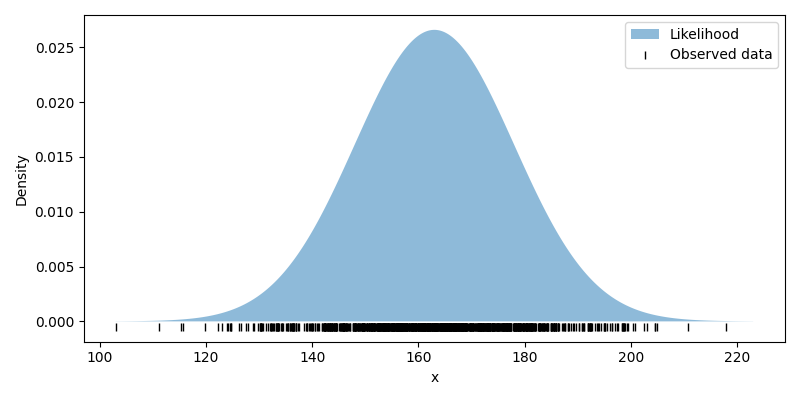
Out:
<matplotlib.legend.Legend object at 0x7f130bd62ca0>
We assume that the likelihood is unknown, and formulate a model to describe
the observed data. The model needs to be implemented as a Python callable,
i.e., a function or a __call__ method in a class, that is parametrized by
the unknown model parameters we aim to infer, here \(\mu\) and
\(\sigma\):
def simulator(mu, sigma, size=1000):
    y_sim = stats.norm(loc=mu, scale=sigma).rvs(size=size)
    return y_sim
Next, we need to reduce the raw data into low-dimensional summary statistics.
The summary statistics calculator also needs to be implemented as a Python
callable. The function must return the summary statistics as a Python
list or numpy.ndarray. Here, we take the mean and standard deviation to
be summary statistics of the data (these are actually sufficient summary
statistics):
def stat_calc(y):
    sum_stats = [numpy.mean(y), numpy.std(y)]
    return sum_stats
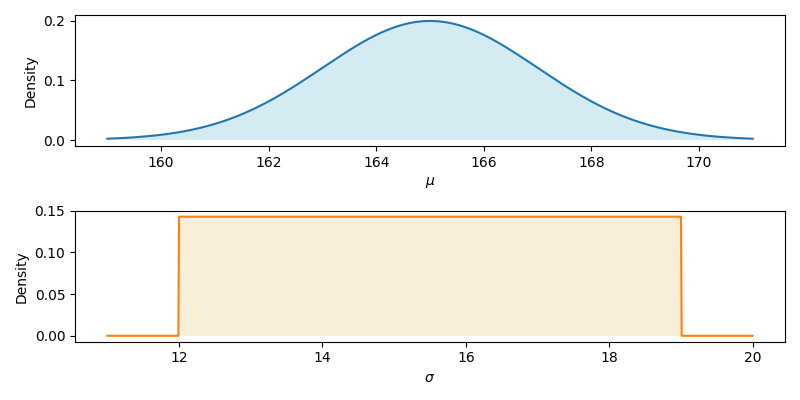
We then place priors over the unknown model parameters using the Prior
class. In the present example, we define the priors:
mu_prior = pylfi.Prior('norm',
                       loc=165,
                       scale=2,
                       name='mu',
                       tex=r'$\mu$'
                       )

sigma_prior = pylfi.Prior('uniform',
                          loc=12,
                          scale=7,
                          name='sigma',
                          tex=r'$\sigma$'
                          )

priors = [mu_prior, sigma_prior]

fig, axes = plt.subplots(nrows=2, figsize=(8, 4), tight_layout=True)
x = np.linspace(159, 171, 1000)
mu_prior.plot_prior(x, ax=axes[0])
x = np.linspace(11, 20, 1000)
sigma_prior.plot_prior(x, color='C1', facecolor='wheat', ax=axes[1])
Total running time of the script: ( 0 minutes 0.347 seconds)